
A lift in the unemployment rate to 6 per cent – its highest point in almost 11 years – will surprise no-one.
In fact, the real surprise has probably been that it has taken this long.
In keeping with the trend of previous jobs reports, the Australian Bureau of Statistics has revealed that a further decline in full-time employment occurred in January, this time by 7100 positions, taking the number of Australians employed full-time to 7.95 million – the lowest number in almost two years.
The reason the unemployment rate has jumped to 6 per cent after spending the latter half of 2013 stubbornly stuck around 5.7 and 5.8 per cent is because, perversely, because the number of discouraged job seekers has stabilised.
The participation rate, the proportion of the working age population in the labour force (ie with a job or actively seeking employment), held steady last month at 64.5 per cent.
Amid all the high-profile announcements about factory closures (most notably and immediately, the SPC cannery in Shepparton), few people will be shocked by confirmation that the unemployment rate has increased.
The number of Australians who want to work but haven’t got a job now stands at 728,600 – a jump of almost 17,000 from last December.
But does this mean the Reserve Bank of Australia will put a rate cut back on its agenda?
That appears unlikely.
The central bank had anticipated that the unemployment rate would at some point reach above 6 per cent, so the fact that it has now done so will not be “new news”.
Additionally, inflation has turned out to be stronger than the RBA had anticipated, making it wary about adding further stimulus to the economy.
As noted in a previous post, RBA Governor Glenn Stevens was unusually explicit following the central bank’s February 4 Board meeting about the future course of interest rates.
Usually, like many central banks, the RBA shies away from being too definitive about the future of monetary policy, which is not unreasonable given the fluidity of global economic and financial conditions.
So when Mr Stevens said the most prudent course for the RBA was “a period of stability in interest rates”, it was a clear message to markets not to expect rate cuts – or hikes – any time soon.
An unemployment rate with a ‘6’ in front of it would not appear to change that message.
Tag Archives: unemployment
Highest unemployment rate in 11 years doesn’t equal interest rate cut
Filed under Uncategorized
Is there a case for a February interest rate hike?
The rate hike hares are running following evidence that shoppers are spending more freely and building approvals are back to levels last seen almost three years ago.
In a sign that the stimulus from low interest rates is sustaining an improvement in consumer outlook despite the soft employment market and federal budget gloom, retail sales rose 0.7 per cent in November to be up 4.6 per cent from a year earlier, while building approvals remained at their healthiest level in years, despite a small retreat from the previous two months.
The solid readings have led at least one prominent economist to predict the Reserve Bank of Australia will soon have to begin raising interest rates in order to ward off the risk of a surge in inflation.
Market Economics managing director Stephen Koukoulas said today the economy “is on fire”, and that the Reserve Bank Board should lift its cash rate when it returns for its first monetary policy meeting of the year on February 4.
The latest readings on the economy follow the release of figures last week showing the nation’s trade deficit narrowed significantly in the second half of 2013, a trend that is expected to continue as the completion of major resource infrastructure projects boosts the nation’s export capacity.
After reaching above $1.5 billion in mid-2013, the deficit had shrunk to little more than $110 million in November, and anecdotal evidence indicates there was strong growth in iron ore export volumes last month.
Adding to the picture, a Dun & Bradstreet survey released earlier this week indicated that business is becoming increasingly upbeat about its investment and employment intentions.
But worries about the health of the jobs market remain.
According to the Australian Bureau of Statistics, monthly job vacancies have been in a sustained decline since reaching a peak of almost 190,000 in early 2011. In November last year, the ABS reported, there were barely 140,000.
In its mid-year update on the economy, Treasury was downbeat on the labour market, predicting the jobless rate would rise to 6.25 per cent next financial year as the economy grew at below-trend rate.
But, as Kouloulas points out, the jobs market is a lagging indicator of economic activity, and the latest economic data suggest Treasury may have been too pessimistic.
For instance, between August and December it cut forecast dwelling investment growth from 5 to 3 per cent, though as it itself admitted, “finance commitments for new dwellings are now 12.4 per cent higher than a year ago and building approvals have improved noticeably from their trough in early 2012. Higher house prices could initiate a stronger investment response”.
The risk for the RBA is that, if it misreads the situation, a rate hike in the next month or so might puncture nascent optimism and slow or stall (at least temporarily) the recovery in non-mining sectors of the economy.
The risk is heightened by the Federal Government’s tub-thumping on the state of the Commonwealth Budget and looming threat of significant cuts in public sector spending.
In addition, raising rates could help reinflate the Australian dollar, something the RBA would be keen to avoid (one of this blog’s correspondents, @MrMacroMan, said that an RBA official speaking in New York overnight was “very clear on AUD risk and rates on hold”).
Yet, if analysts like Koukoulas are correct and the economy is taking off, an official interest rate of 2.5 per cent would obviously be inappropriate, and could sow the seeds of dangerous price pressures down the track.
As RBA Governor Glenn Stevens might say, the decision may come down to which is the path of last regret.
Fortunately for it, more evidence about the strength of activity is due to be released before the 4 February meeting, including finance and employment figures, as well as construction activity numbers.
In the meantime, markets are likely to be busily recalculating the odds of a rate move at next month’s meeting.
Filed under Uncategorized
No more rate cuts, but no rush to tighten yet
Interest rates look set to head higher, but the RBA’s “considerable uncertainty” about the pace of recovery in much of the economy means the first rate hike of the cycle could be delayed until well into 2014.
In a widely-anticipated decision, the RBA Board has decided to hold the cash rate at 2.5 per cent – meaning it will have been at this historically low level for six months by the time of the Board’s next meeting on February 4.
There is clear evidence that low interest rates are having an effect.
The property market is strengthening (house prices have risen, building approvals are up 23 per cent from a year ago), company profits are growing (up almost 9 per cent in 12 months), shares are rising (up 20 per cent in the year to date), and retail sales are increasing at a sustained solid clip (three consecutive monthly increases of 0.5 per cent or greater).
And the central bank thinks there is more of such news to come.
As RBA Governor Glenn Stevens put it today, “The full effects of these decisions [to ease monetary policy] are still coming through, and will be for a while yet”.
This is coupled with tentative signs that activity in the non-mining parts of the economy is picking up.
Official capital expenditure data showed manufacturers and other businesses were gradually increasing their investment, and the latest report from credit reporting firm Dun & Bradstreet showed 10 per cent of firms intend to hire extra staff in the first quarter of 2014.
If this is accurate, and businesses act on their hiring intentions, the unemployment rate may not rise much higher.
In further promising news, the official GDP numbers for the September quarter, due out tomorrow, may also be a bit stronger than many have been predicting.
The Australian Bureau of Statistics threw in a surprise today with its report that the trade surplus surged more than 50 per cent in three months to almost $9 billion, adding around 0.7 of a percentage point to activity in the September quarter.
The RBA’s known unknowns: the dollar and non-mining activity
But the persistently strong dollar and the sputtering recovery in economic activity outside the mining sector are the two greatest areas of uncertainty for the Reserve Bank.
Continuing recent efforts to talk the currency down, Stevens said the dollar (which was trading at just below US91 cents following the RBA announcement) was “still uncomfortably high”.
He almost didn’t need to add that the high exchange rate will have to come down in order for the economy to achieve “balanced” growth.
On this front, the Governor admitted that expectations for an acceleration in activity outside the mining sector were subject to “considerable uncertainty”.
Market Economics managing director Stephen Koukoulas is one of the few who for some time now have been predicting rates to rise in 2014 – he tips in the first three months of next year.
But the strong dollar could make it hesitate.
Koukoulas, for one, thinks there is much more the RBA needs to do much more to get the currency down – jawboning alone has had little effect.
If he is right, look for big sell-offs of the currency in coming days.
Filed under Uncategorized
A shortage of jobs, but no shortage of work
In contemporary Australia there might be a (relative) shortage of jobs, but it seems there is no shortage of work.
While the unemployment rate hovers just below 6 per cent (it held steady at 5.7 per cent last month according to the latest official labour force figures), just about anyone with a job will tell you that their work demands are rising relentlessly.
So what is going on?
The latest official employment figures are consistent with a trend that emerged in the middle of last year in which employment growth is slowing but hours worked is accelerating (see Reserve Bank of Australia chart of labour input growth below).
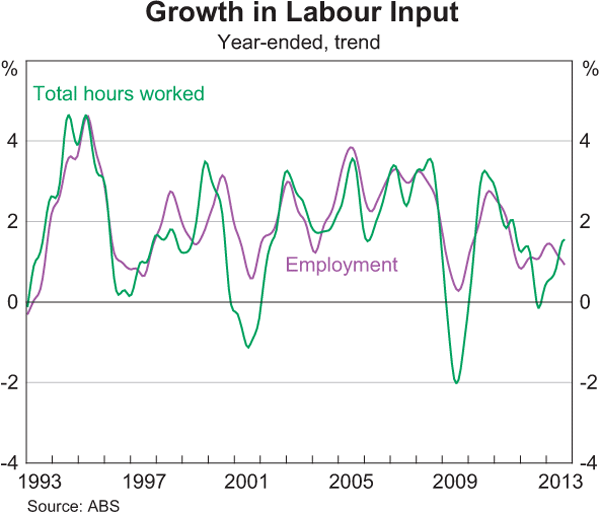
According to the Australian Bureau of Statistics, aggregate hours worked increased marginally in both trend and seasonally adjusted terms last month, while employment and unemployment were flat (a net 1100 jobs were created, while an additional 9000 job seekers joined the labour market).
The increase in pressure on those still with a job has been accentuated by the inclination of employers to take on part-timers over full-time staff – in the 12 months to October, 53,000 full-time jobs were lost, while during the same period 145,000 part-time positions were added.
Business surveys and the latest job ads report from the Australia and New Zealand Banking Group suggest wary employers are reluctant to take on extra staff. According to the ANZ, the number of job ads has bottomed in the last two months after falling for most of the year, while an Australian Chamber of Commerce and Industry index of labour market conditions reached a four-year low of 43.6 points in the September quarter.
It is not hard to see why: though low interest rates have injected some vigour into the housing sector, the economy remains sluggish.
As RBA Governor Glenn Stevens observed earlier this week, the economy is still fumbling its way forward as the mining investment boom rapidly dissipates and other sources of growth are yet to establish themselves.
Couple this with the continued strength of the dollar and tepid global growth, and it is little wonder businesses are reluctant to take on extra staff.
Instead, as the data indicate, employers are choosing to use their existing workforce to cope with any increase in demand.
This is why those who have a job feel like they are working twice as hard, even as hundreds of thousands are banging on the door looking for employment.
Filed under Uncategorized
 Outlier