Tag Archives: saving

Growth numbers suggest Abbott should be careful in cutting

As the Abbott Government’s Commission of Audit hunts for spending cuts and bureaucratic flab, the latest national accounts might give it some pause for thought about how zealous it should be.

The figures show that public spending added a hefty 1.3 percentage points to growth in the September quarter – without this contribution the already decidedly-anaemic GDP numbers (up 0.6 per cent in the quarter, 2.3 per cent for 12 months) would have been much worse.

As the numbers make clear, this is a fragile time for the economy, with a hesitant transition underway from mining investment toward other sources of growth.

Housing activity is strengthening, but the lift in the household savings ratio to 11.1 per cent is a fair indicator that although consumer confidence is improving, people remain cautious. (No doubt the urge to save was heightened by the air of uncertainty that surrounds any federal election, but the tepid labour market is probably a more lasting influence).

There are undoubtedly savings to be had in public spending, but in the zeal to make cuts, the Government needs to keep in mind that the public sector is not just a cost centre – it purchases goods and services, and it employs people, giving them the wherewithal to make their own purchases.

Australia is a long, long way from southern Europe, geographically and economically, but the experience of countries like Greece and Spain show that ill-timed austerity can make things far worse.
  

Leave a comment

Filed under Uncategorized

ABS to give full reckoning of household wealth

There are plenty of reasons why households tighten their belts or splurge out on an overseas holiday.

But until now, the National Accounts have only shone a light on part of the picture – income – when it comes to explaining spending and saving behaviour.

That will change from next month when, for the first time, the National Accounts will include a quarterly report on the Household Balance Sheet that incorporates the effect of house prices, shares, superannuation and other assets as well as income on household net worth.

This is of more than just academic interest.

As the Australian Bureau of Statistics itself has pointed out, non-financial assets are a huge piece of the puzzle when it comes to evaluating real household worth, because they are about two-thirds larger than the value of financial assets.

As the ABS coyly admitted, this was “a significant data gap”.

In an explanatory note announcing the change, the Australian Bureau of Statistics has presented an analysis of how household net worth plunged when the global financial crisis hit hard in the second half of 2008.

Between March 2008 and June 2009, it plunged from around $6 trillion to close to $5 trillion, with much of the decline stemming from falls in the value of land, shares and superannuation accounts rather than cuts to income.

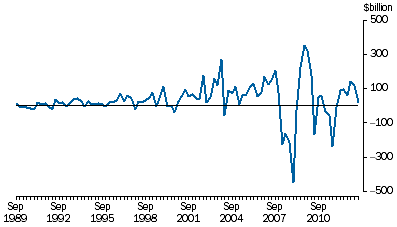
The ABS has prepared a Household Balance Sheet chart that demonstrates how these losses will be captured by the new analysis (see below).

Household Balance Sheet

It shows the balance of household net savings and other measures of real net wealth plunged from around $200 billion in late 2007 to almost negative $500 billion in the December quarter of 2008.

As the ABS notes, “much of the decline in household net worth in December 2008 is explained by large real holding losses on land and financial assets”. That is, the plunge in house and share prices (and the flow on effect to superannuation accounts) sent household net worth into a tailspin.

Importantly, these “paper” losses had immediate effects on behaviour. Households tightened their belts, cutting back on spending and increasing saving.

This change in behaviour, along with a recovery in house prices, helped to quickly send the household balance sheet back into positive territory.

Since the plunge in the balance sheet in late 2008, there have been two other periods in which it has fallen into negative territory before recovering – early-to-mid 2010 and mid-2011.

What may concern policymakers and businesses that depend on households to spend, is that the ABS chart shows the Household Balance Sheet has again turned down and is close to zero.

Strengthening housing and share markets might turn that around, but elevated unemployment and flat real income growth won’t provide much support.

Leave a comment

Filed under Uncategorized