Tag Archives: Reserve Bank of Australia

Record-breaking run on inflation in sight

As it contemplates what has been an extraordinarily white knuckle few weeks for the global economy (courtesy of the insanity of sections of the Republican Party), at least one thing the Reserve Bank of Australia Board is  unlikely to worry about when it meets in a couple of weeks is domestic inflation.

The September quarter Consumer Price Index figures due out on Wednesday are expected to confirm that, whatever else might be going on the economy, it’s not happening in prices.

If they show, as tipped, that underlying inflation increased by around 0.5 per cent for the quarter, it will mean the nation is heading into the fourth consecutive year in which price pressures have been contained within the 2 to 3 per cent target band set by the central bank.

Since mid-2010, annual growth in underlying inflation has not reached any higher than 2.85 per cent, and has remained stuck around 2.4 per cent for more than a year.

Laudable as this result may be, it is not really remarkable.

In the sweep of time since the recession of the late 80s/early 90s and the establishment of an independent central bank, inflation has been largely well behaved – apart from a few quarters following the introduction of the GST in 2001 and the growing pains caused by the resources boom during 2007 and 2008 (see RBA chart below).
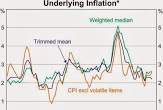
Underlying inflation 1993-2013 - RBA

If the RBA is correct in its view that inflation will remain within its target band for at least the next two years, it will mean more than five years of moderate price growth – a record-breaking achievement, exceeding the previous high of four consecutive years from mid-2002 when annual underlying inflation stayed between 2 to 3 per cent.

For a central bank which has as part of its mandate the containment of price pressures, this will be a signal achievement.

It also means that politicians may have to update their rhetoric and ditch the trusty old trope of “household cost of living pressures”.

For all the talk about cost of living pressures, there is little sign of them in the figures.*

* There is an argument to be had about whether the Australian Bureau of Statistics, with its CPI methodology, accurately encapsulates what households spend their money on, but this is a subject for a future post.

2 Comments

Filed under Uncategorized

Flat retail leaves rate cut door open

No wonder the Reserve Bank of Australia appears so comfortable with the inflation outlook.

When retail sales fail to grow in a quarter, and edge just 1.1 per cent higher in the course of a year, that tells you everything you need to know about the extent of consumer caution and a lack of pricing power among retailers.

For a central bank contemplating a cash rate cut to 2.5 per cent, the environment doesn’t get much more unthreatening than this.

And the RBA Board, when it meets tomorrow, will have to taker into account the market’s emphatic expectation that monetary policy will be eased.

But this rate cut will not be the political tonic that governments usually get from moves that make borrowing cheaper – this time around it is a potent sign of how soft conditions in the economy have become – and how much more work the RBA may yet have to do.

Leave a comment

Filed under Analysis

Kevin or Tony, business grinds on regardless

At about this point before every federal election, someone comes out and complain that political uncertainty is undermining business confidence and hurting investment.

True to form, business leaders were reported by The Australian earlier this week crying that doubts over when the election would be held were “sabotaging jobs and investment”.

We are led to believe that right now across the country, company boards, HR managers and purchasing departments are in a fit of angst about the current state of political flux, delaying crucial hiring and investment decisions as they wait on the Prime Minister to make the short drive to Government House to call the nation to the polls.

If this is the case, it must be an excruciating time for job seekers, merchant bankers, car salesmen and just about anyone else with something to sell.

It would mean that every three years or so – whenever an election looms – economic activity is brought to a virtual standstill as the nation awaits the verdict.

Problem is that, as with much received wisdom, it doesn’t stand up to much scrutiny.

Even a cursory inspection of official investment and employment figures suggests little correlation between election timing and swings in activity.

For instance, in the months leading up to the November 2001 election, private capital expenditure was regaining its momentum after having been savaged by the tech wreck. By the end of the year it had reached annual growth rate of almost 5 per cent – a 10 percentage point turnaround from the March quarter.

And again, in 2004, capex growth slowed in the three months to June to an annual rate of 2.5 per cent before accelerating sharply in the second half of the year to reach above 12 per cent in the December quarter – right when the election was held.

Of course, it has not all been one-way traffic.

Business investment was on a prolonged slide in the months leading up to the March 1996 election, when the Keating Government was dumped in a landslide.

But even here, other factors seemed to be at play.

Quarterly investment growth actually bottomed out the previous June (when it virtually stalled), and strengthened in the six months leading into the election. Maybe it was just that business was confident a change of government was on the cards.

The labour market similarly provides little support for the theory.

Just take these two examples.

In lead-up to, and aftermath of, the fractious August 2010 election, uncertainty about who would form government, and on what terms, was at an all-time high.

But throughout this extremely unsettled period, covering March to October, an extra 180,000 jobs were created, and total employment grew 1.6 per cent.

In 2007, the unemployment rate hovered at or below 4.3 per cent for the six months leading up to the November election, and rose only marginally to 4.5 per cent at election time before quickly reverting to 4.3 per cent the following month.

This is not to say that elections and the prospect of a change of government have no effect on businesses and the investment and hiring decisions they make.

Obviously, if the Federal Government is one of your important customers or a major employer in your area, you could well have a lot riding on the outcome of the poll (though neither side looks likely to unshackle Commonwealth spending any time soon).

But equally obviously, for most employers and investors the election and a possible change of government is only one of a number of considerations, and probably not a major one.

In the ebb and flow of domestic and international commerce, whether it is Kevin or Tony is ultimately neither here nor there – despite what people may claim.


Leave a comment

Filed under Analysis

Yes, you heard it right: RBA says embrace risk

It is not often that you hear a central banker urge people to take on risk.

But that was the unexpected pitch from Reserve Bank of Australia Governor Glenn Stevens yesterday as he pondered where growth would come from now that the mining investment boom has all but ended.

In an intriguing passage in his speech to the Anika Foundation in Sydney, Stevens made it clear that nervous savers were in the policy sights of the central bank.

He said that, in lowering interest rates, it had been the RBA’s intention to prod nervous savers into backing out of increasingly expensive safe havens and instead start searching for growth.

As the Governor put it, “One of the things we have been watching for as we have been reducing interest rates has been an indication of savers shifting portfolios towards some of the slightly more risky asset classes, as that is one of the expected and intended effects of monetary policy easing”.

So there you have it, an endorsement from the RBA to take on more risk.

Australia’s central bank, like many others around the world, has done much of the policy work to support growth as governments have concentrated on budget repair and businesses have shied away from debt.

In comments that have imparted fresh momentum to rate cut speculation, Stevens said there was no “serious impediment” to easing monetary policy from its already “very accommodative” setting of 2.75 per cent.

Following his remarks, markets put the odds of a cash rate cut to 2.5 per cent when the RBA Board meets next Tuesday at 94 per cent.

But by his own admission, the Governor is unsure this will be enough to bring about a vital turnaround in confidence.

“It is somewhat concerning that the business community’s confidence has been quite subdued in recent times,” Stevens said. “It would be good if there was a bit more confidence in the business community about the future. Unfortunately…there’s no such thing as a ‘confidence policy lever’.”

The dour mood of business has meant investment in the non-mining sector remains soft, raising the prospect that economic activity – already below average – will slip even lower as the investment phase of the mining boom peters out.

It has also meant that funds that might otherwise go into productive investments have instead been locked up in conservative low-growth but relatively secure assets.

As Stevens said, this has come at a cost to both investors and the economy: “With many investors wanting safety, the price of safety has risen”.

Flagging that more rate cuts may be on the cards, he warned the price would probably have to rise even higher to encourage more adventurous use of funds.

“It [the price] has to rise by enough to prompt at least some people to start to shift their portfolios in the direction of taking some more risk – by holding equities, physical assets and so on, though obviously we don’t want too much risk-taking,” he said.

When even a central banker is urging investors to take a few more chances, you know the flight to security has gone too far.

Leave a comment

Filed under Analysis