Tag Archives: inflation

Record-breaking run on inflation in sight

As it contemplates what has been an extraordinarily white knuckle few weeks for the global economy (courtesy of the insanity of sections of the Republican Party), at least one thing the Reserve Bank of Australia Board is  unlikely to worry about when it meets in a couple of weeks is domestic inflation.

The September quarter Consumer Price Index figures due out on Wednesday are expected to confirm that, whatever else might be going on the economy, it’s not happening in prices.

If they show, as tipped, that underlying inflation increased by around 0.5 per cent for the quarter, it will mean the nation is heading into the fourth consecutive year in which price pressures have been contained within the 2 to 3 per cent target band set by the central bank.

Since mid-2010, annual growth in underlying inflation has not reached any higher than 2.85 per cent, and has remained stuck around 2.4 per cent for more than a year.

Laudable as this result may be, it is not really remarkable.

In the sweep of time since the recession of the late 80s/early 90s and the establishment of an independent central bank, inflation has been largely well behaved – apart from a few quarters following the introduction of the GST in 2001 and the growing pains caused by the resources boom during 2007 and 2008 (see RBA chart below).
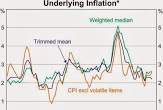
Underlying inflation 1993-2013 - RBA

If the RBA is correct in its view that inflation will remain within its target band for at least the next two years, it will mean more than five years of moderate price growth – a record-breaking achievement, exceeding the previous high of four consecutive years from mid-2002 when annual underlying inflation stayed between 2 to 3 per cent.

For a central bank which has as part of its mandate the containment of price pressures, this will be a signal achievement.

It also means that politicians may have to update their rhetoric and ditch the trusty old trope of “household cost of living pressures”.

For all the talk about cost of living pressures, there is little sign of them in the figures.*

* There is an argument to be had about whether the Australian Bureau of Statistics, with its CPI methodology, accurately encapsulates what households spend their money on, but this is a subject for a future post.

2 Comments

Filed under Uncategorized

Low inflation gives room for rate cut, but no trigger

The Reserve Bank of Australia has ample room to cut interest rates if needed following evidence that inflation was muted in the June quarter, but an August rate cut remains unlikely.

While the central bank appears in no rush to ease monetary policy from its already very-low 2.75 per cent, confirmation that headline inflation grew by just 0.4 per cent in the June quarter, pushing annual growth down by 0.1 of a percentage point to 2.4 per cent, suggests it could cut the cash rate further without immediately feeding a dangerous build-up in inflation.

But the Reserve Bank is likely to keep a wary eye on underlying price pressures, particularly as the weaker dollar means the cost of imports is set to grow more sharply.

Official figures show underlying inflation grew by 0.6 per cent in the June quarter, holding the annual rate steady at 2.4 per cent – just below the middle of the central bank’s 2 to 3 per cent target band.

The most significant price increases in the quarter were for hospitals and medical services (up 3.4 per cent), tobacco (3 per cent), furniture (4.8 per cent) and rents (1.1 per cent).

These were largely offset by falls in the cost of domestic tourism (down 4 per cent) and cheaper fuel (down 3 per cent).

There is nothing in the result that will surprise the RBA, which has said it expects inflation to remain “consistent with the target” for the foreseeable future.

The central bank is likely to closely monitor the evolution of inflation pressures from overseas following the rapid depreciation of the dollar since April.

This effect is yet to show up consistently in the official inflation numbers.

The average price of tradeable goods and services – which comprise about 40 per cent of the consumer price index – rose by just 0.3 per cent in the June quarter, while average inflation among non-tradeable products was 0.5 per cent, mainly due to the pick up in housing activity.

The extent to which the high dollar and fierce international competition has helped hold inflation down was underlined by figures showing tradeables inflation fell 0.7 per cent in the 12 months to June, compared with a 4.3 per cent rise in non-tradeable prices.

Leave a comment

Filed under Analysis