Tag Archives: housing

A good week for the RBA

Every now and then you have a week when things seem to go right – your baby son suddenly begins sleeping soundly and copiously, you get the perfect park at work – twice! – and your bank gets in touch to say it has made a $100 mistake in your favour, and lets you keep it (ok, so that last one never happens, it is just a dream).

The Reserve Bank of Australia has just had such a week.

When the RBA Board sits down tomorrow for its monthly monetary policy meeting, it will see little reason to move the official cash rate.

All the signs are that the economy is behaving in ways that it has anticipated, and that are broadly in keeping with its monetary policy stance.

Low interest rates appear to be working to encourage activity in non-mining parts of the economy, particularly housing, while the dollar is depreciating and worrying price pressures are yet to appear.

Though there was a slip in building approvals last month (down 1.8 per cent), much of this was due to the volatile apartments segment of the market, and annual growth remains a healthy 23.1 per cent.

Of course, holding interest rates at historically low levels for an extended period carries with it risk, and some have started to fret that a bubble in the housing market, particularly in Sydney, is developing.

But the overblown talk of an over-heating property market, never well-founded, looks increasingly silly. Sure, house prices have surged in the major cities – most notably Sydney and Melbourne – but there are at least three good reasons to dismiss talk of a bubble at this stage. Firstly, there are signs that the market in established housing is losing some of its heat and price growth is easing. Secondly, and perhaps most importantly, credit growth remains modest – borrowing for housing grew by 0.5 per cent in each of September and October to be up 5 per cent from a year earlier, which is hardly what could be described as “bubble-like”. Thirdly, the nation’s population is growing at a solid rate of around 1.8 per cent, and the easing dollar makes Australian property an increasingly attractive proposition for foreign investors.

There are also encouraging signs that manufacturers and other businesses are starting to pick up the pace of their investment – a development that is coming none too soon, given the rapid deceleration in mining investment.

Official figures show that in the September quarter, mining companies cut their spending on plant and equipment by 7.1 per cent (while expenditure on buildings and structures increased 5.6 per cent). In the same period, manufacturers spent an extra 3 per cent on plant and equipment, and increased funds for buildings by 1.5 per cent.

Any investment plans should be well supported by healthy balance sheets. The Australian Bureau of Statistics confirmed today that business profits grew almost 4 per cent in the September quarter and are up almost 9 per cent in the past year. In the same period, wages have grown 3.1 per cent.

While GDP figures out on Wednesday are likely to show the economy was just ticking over in the September quarter, evidence that non-mining activity is building should push consideration of more rate cuts further into the background.

Instead, the RBA Board may soon begin to consider the timing of a rate hike.

Though it is unlikely to make such a move tomorrow, the central bank will be heartened by the dollar’s slide in recent days. Governor Glenn Stevens made it clear again last week that he thought its sustained strength against the greenback has been increasingly difficult to justify.

Inflation and wages appear well contained for now, but the longer the cash rate is kept at 2.5 per cent, the greater the risk prices could accelerate, which would in turn increase pressure for wage hikes.

As ever for a central bank, the trick is in the timing. Push up rates too soon or too fast, and the dollar could rebound, but leave them low for too long and potentially destabilising price pressures could accumulate.


Leave a comment

Filed under Uncategorized

ABS to give full reckoning of household wealth

There are plenty of reasons why households tighten their belts or splurge out on an overseas holiday.

But until now, the National Accounts have only shone a light on part of the picture – income – when it comes to explaining spending and saving behaviour.

That will change from next month when, for the first time, the National Accounts will include a quarterly report on the Household Balance Sheet that incorporates the effect of house prices, shares, superannuation and other assets as well as income on household net worth.

This is of more than just academic interest.

As the Australian Bureau of Statistics itself has pointed out, non-financial assets are a huge piece of the puzzle when it comes to evaluating real household worth, because they are about two-thirds larger than the value of financial assets.

As the ABS coyly admitted, this was “a significant data gap”.

In an explanatory note announcing the change, the Australian Bureau of Statistics has presented an analysis of how household net worth plunged when the global financial crisis hit hard in the second half of 2008.

Between March 2008 and June 2009, it plunged from around $6 trillion to close to $5 trillion, with much of the decline stemming from falls in the value of land, shares and superannuation accounts rather than cuts to income.

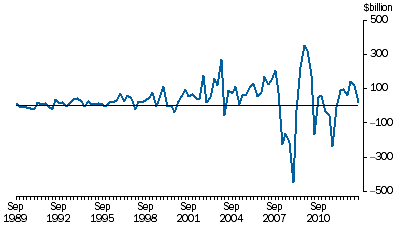
The ABS has prepared a Household Balance Sheet chart that demonstrates how these losses will be captured by the new analysis (see below).

Household Balance Sheet

It shows the balance of household net savings and other measures of real net wealth plunged from around $200 billion in late 2007 to almost negative $500 billion in the December quarter of 2008.

As the ABS notes, “much of the decline in household net worth in December 2008 is explained by large real holding losses on land and financial assets”. That is, the plunge in house and share prices (and the flow on effect to superannuation accounts) sent household net worth into a tailspin.

Importantly, these “paper” losses had immediate effects on behaviour. Households tightened their belts, cutting back on spending and increasing saving.

This change in behaviour, along with a recovery in house prices, helped to quickly send the household balance sheet back into positive territory.

Since the plunge in the balance sheet in late 2008, there have been two other periods in which it has fallen into negative territory before recovering – early-to-mid 2010 and mid-2011.

What may concern policymakers and businesses that depend on households to spend, is that the ABS chart shows the Household Balance Sheet has again turned down and is close to zero.

Strengthening housing and share markets might turn that around, but elevated unemployment and flat real income growth won’t provide much support.

Leave a comment

Filed under Uncategorized

Strong dollar casts cloud over outlook

The strong Australian dollar is keeping the Reserve Bank of Australia on edge as it observes tentative signs of improvement in the non-mining sectors of the economy.

The central bank appears likely to hold interest rates steady well into 2014 as it tries to assess how competing forces – the boost to activity from record low interest rates against the depressive effects of a high dollar, rapidly receding mining investment and below-average global growth – will work on the economy over the next few months.

The RBA has taken heart from evidence that a string of rate cuts that have pushed the cash rate down to 2.5 per cent are biting, and households are shedding much of their recent caution and life is coming back into the housing and equity markets.

As evidence of this, it points to increased demand from households for finance and a shift among savers away from low-risk assets.

In a clear warning for those hoping for more official interest rate cuts, RBA Governor Glenn Stevens said that the full effects of the rate cuts made this year are yet to be felt.

But nor does the RBA seem to be in a hurry to hike rates back toward more normal levels.

Its chief concern is the continued strength of the dollar, which has sat around the 95 US cents mark for the past month.

At this level, Stevens said, it “is still uncomfortably high. A lower level of the exchange rate is likely to be needed to achieve balanced growth in the economy”.

The RBA’s ability exert influence on the exchange rate is minor – mainly through the interest rate differential between Australian and US official interest rates – but at the margin it could encourage the central bank to hold rates lower for longer.

Another argument to keep interest rates down is doubts about how durable recent improvements in non-mining activity may be. As Stevens admitted, although private demand outside the mining sector was expected to pick up, “considerable uncertainty surrounds this outlook”.

Another concern is the move by the big banks to begin inching up their lending rates, irrespective of the stable cash rate.

There is probably never a particularly comfortable time to be a central banker, but the next few months could be a particularly white knuckle time.


Leave a comment

Filed under Uncategorized