
Don’t expect interest rates to go up any time soon but, equally, don’t expect them to go down – that was the clear message from the Reserve Bank today.
In unusually direct language, RBA Governor Glenn Stevens has moved to lay to rest interest rate speculation for the next few months, saying the most prudent course for the central bank to take was likely to be “a period of stability in interest rates”.
That is central bank speak for everyone – those predicting imminent rate rises, and those calling for rate cuts – to take a Bex and calm down.
As mortgage holders ponder the pros and cons of fixing part of their loan, and investors do their credit sums, the Reserve Bank has tried to give some reassurance by flagging official rates are not likely to move for some time yet.
As widely tipped, the RBA has decided to hold the official cash rate at 2.5 per cent this month.
What many may not have anticipated though, was the central bank’s unusual willingness to flag its interest rate intentions.
Following the Reserve Bank Board’s first meeting for 2014, Mr Stevens released a statement that showed the RBA is in no rush to change its policy settings.
“On present indications, the most prudent course is likely to be a period of stability in interest rates,” he said.
The Reserve Bank sees no compelling reasons yet for either a rate increase, or a rate cut.
Unexpectedly strong inflation growth in the December quarter (underlying inflation grew by 0.9 per cent to be up 2.6 per cent from a year earlier), along with the falling exchange rate and increased housing activity, had prompted some to speculate that the RBA would soon have to consider raising the c ash rate.
But while Governor Stevens admitted monetary policy was “accommodative”, interest rates were “very low”, and house prices have surged, there was as no yet sign of a dangerous build up in indebtedness. In fact, household credit growth is moderate.
On inflation, the central bank so far does not seem to be phased by the jump in prices in December, some of which it attributed to importers and retailers quickly passing through to consumers much of the increase in costs caused by the easing exchange rate.
Mr Stevens said that although inflation was stronger than the central bank had predicted when it released its most recent Statement on Monetary Policy late last year, it was “still consistent with the 2 to 3 per cent target over the next two years”.
Those arguing the case for a rate cut have pointed to the nation’s anaemic growth rate (2.3 per cent in the 12 months to the September quarter 2013), a plunge in mining investment and weak labour market (the economy shed almost 32,000 full-time jobs in December and the unemployment rate is expected to rise above its current 5.8 per cent) to show the need for more support for activity.
But to this line of argument, Mr Stevens said monetary policy was “appropriately configured” to foster growth in demand (ie don’t expect them to go any lower).
Of course, the RBA might be considering the possibility (raised by Deloitte Access Economics director Chris Richardson) that commercial banks will lower their lending rates as they secure cheaper sources of funding on international markets. The Governor’s statement gives no hint on this front, except to say that long-term interest rates and risk spreads remain low, and there is adequate funding available through credit and equity markets.
As the economy gropes toward sources of growth to replace the sugar hit from resources investment, conditions are likely to stay rocky and uncertain.
In this shifting economic environment the RBA has moved to provide consumers and investors with one welcome point of consistency, at least for the next few months.
Tag Archives: CPI
RBA locks in 2.5 per cent cash rate – for now
Filed under Uncategorized
Record-breaking run on inflation in sight
As it contemplates what has been an extraordinarily white knuckle few weeks for the global economy (courtesy of the insanity of sections of the Republican Party), at least one thing the Reserve Bank of Australia Board is unlikely to worry about when it meets in a couple of weeks is domestic inflation.
The September quarter Consumer Price Index figures due out on Wednesday are expected to confirm that, whatever else might be going on the economy, it’s not happening in prices.
If they show, as tipped, that underlying inflation increased by around 0.5 per cent for the quarter, it will mean the nation is heading into the fourth consecutive year in which price pressures have been contained within the 2 to 3 per cent target band set by the central bank.
Since mid-2010, annual growth in underlying inflation has not reached any higher than 2.85 per cent, and has remained stuck around 2.4 per cent for more than a year.
Laudable as this result may be, it is not really remarkable.
In the sweep of time since the recession of the late 80s/early 90s and the establishment of an independent central bank, inflation has been largely well behaved – apart from a few quarters following the introduction of the GST in 2001 and the growing pains caused by the resources boom during 2007 and 2008 (see RBA chart below).
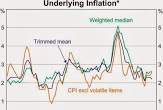
If the RBA is correct in its view that inflation will remain within its target band for at least the next two years, it will mean more than five years of moderate price growth – a record-breaking achievement, exceeding the previous high of four consecutive years from mid-2002 when annual underlying inflation stayed between 2 to 3 per cent.
For a central bank which has as part of its mandate the containment of price pressures, this will be a signal achievement.
It also means that politicians may have to update their rhetoric and ditch the trusty old trope of “household cost of living pressures”.
For all the talk about cost of living pressures, there is little sign of them in the figures.*
* There is an argument to be had about whether the Australian Bureau of Statistics, with its CPI methodology, accurately encapsulates what households spend their money on, but this is a subject for a future post.
Filed under Uncategorized
 Outlier