Tag Archives: central bank

Record-breaking run on inflation in sight

As it contemplates what has been an extraordinarily white knuckle few weeks for the global economy (courtesy of the insanity of sections of the Republican Party), at least one thing the Reserve Bank of Australia Board is  unlikely to worry about when it meets in a couple of weeks is domestic inflation.

The September quarter Consumer Price Index figures due out on Wednesday are expected to confirm that, whatever else might be going on the economy, it’s not happening in prices.

If they show, as tipped, that underlying inflation increased by around 0.5 per cent for the quarter, it will mean the nation is heading into the fourth consecutive year in which price pressures have been contained within the 2 to 3 per cent target band set by the central bank.

Since mid-2010, annual growth in underlying inflation has not reached any higher than 2.85 per cent, and has remained stuck around 2.4 per cent for more than a year.

Laudable as this result may be, it is not really remarkable.

In the sweep of time since the recession of the late 80s/early 90s and the establishment of an independent central bank, inflation has been largely well behaved – apart from a few quarters following the introduction of the GST in 2001 and the growing pains caused by the resources boom during 2007 and 2008 (see RBA chart below).
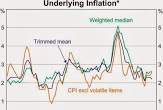
Underlying inflation 1993-2013 - RBA

If the RBA is correct in its view that inflation will remain within its target band for at least the next two years, it will mean more than five years of moderate price growth – a record-breaking achievement, exceeding the previous high of four consecutive years from mid-2002 when annual underlying inflation stayed between 2 to 3 per cent.

For a central bank which has as part of its mandate the containment of price pressures, this will be a signal achievement.

It also means that politicians may have to update their rhetoric and ditch the trusty old trope of “household cost of living pressures”.

For all the talk about cost of living pressures, there is little sign of them in the figures.*

* There is an argument to be had about whether the Australian Bureau of Statistics, with its CPI methodology, accurately encapsulates what households spend their money on, but this is a subject for a future post.

2 Comments

Filed under Uncategorized

Flat retail leaves rate cut door open

No wonder the Reserve Bank of Australia appears so comfortable with the inflation outlook.

When retail sales fail to grow in a quarter, and edge just 1.1 per cent higher in the course of a year, that tells you everything you need to know about the extent of consumer caution and a lack of pricing power among retailers.

For a central bank contemplating a cash rate cut to 2.5 per cent, the environment doesn’t get much more unthreatening than this.

And the RBA Board, when it meets tomorrow, will have to taker into account the market’s emphatic expectation that monetary policy will be eased.

But this rate cut will not be the political tonic that governments usually get from moves that make borrowing cheaper – this time around it is a potent sign of how soft conditions in the economy have become – and how much more work the RBA may yet have to do.

Leave a comment

Filed under Analysis

Kevin or Tony, business grinds on regardless

At about this point before every federal election, someone comes out and complain that political uncertainty is undermining business confidence and hurting investment.

True to form, business leaders were reported by The Australian earlier this week crying that doubts over when the election would be held were “sabotaging jobs and investment”.

We are led to believe that right now across the country, company boards, HR managers and purchasing departments are in a fit of angst about the current state of political flux, delaying crucial hiring and investment decisions as they wait on the Prime Minister to make the short drive to Government House to call the nation to the polls.

If this is the case, it must be an excruciating time for job seekers, merchant bankers, car salesmen and just about anyone else with something to sell.

It would mean that every three years or so – whenever an election looms – economic activity is brought to a virtual standstill as the nation awaits the verdict.

Problem is that, as with much received wisdom, it doesn’t stand up to much scrutiny.

Even a cursory inspection of official investment and employment figures suggests little correlation between election timing and swings in activity.

For instance, in the months leading up to the November 2001 election, private capital expenditure was regaining its momentum after having been savaged by the tech wreck. By the end of the year it had reached annual growth rate of almost 5 per cent – a 10 percentage point turnaround from the March quarter.

And again, in 2004, capex growth slowed in the three months to June to an annual rate of 2.5 per cent before accelerating sharply in the second half of the year to reach above 12 per cent in the December quarter – right when the election was held.

Of course, it has not all been one-way traffic.

Business investment was on a prolonged slide in the months leading up to the March 1996 election, when the Keating Government was dumped in a landslide.

But even here, other factors seemed to be at play.

Quarterly investment growth actually bottomed out the previous June (when it virtually stalled), and strengthened in the six months leading into the election. Maybe it was just that business was confident a change of government was on the cards.

The labour market similarly provides little support for the theory.

Just take these two examples.

In lead-up to, and aftermath of, the fractious August 2010 election, uncertainty about who would form government, and on what terms, was at an all-time high.

But throughout this extremely unsettled period, covering March to October, an extra 180,000 jobs were created, and total employment grew 1.6 per cent.

In 2007, the unemployment rate hovered at or below 4.3 per cent for the six months leading up to the November election, and rose only marginally to 4.5 per cent at election time before quickly reverting to 4.3 per cent the following month.

This is not to say that elections and the prospect of a change of government have no effect on businesses and the investment and hiring decisions they make.

Obviously, if the Federal Government is one of your important customers or a major employer in your area, you could well have a lot riding on the outcome of the poll (though neither side looks likely to unshackle Commonwealth spending any time soon).

But equally obviously, for most employers and investors the election and a possible change of government is only one of a number of considerations, and probably not a major one.

In the ebb and flow of domestic and international commerce, whether it is Kevin or Tony is ultimately neither here nor there – despite what people may claim.


Leave a comment

Filed under Analysis

Forget business gloom, ABS revisions suggest housing on the rise

Hopes for an August interest rate cut look increasingly precarious.

Earlier in the week, the Minutes of the Reserve Bank of Australia Board’s July 2 showed the central bank was happy with its current policy settings, and gave no hint of a immediate desire to ease monetary policy further.

In fact, the RBA wants to see the effects of recent rate cuts – which it said were only starting to feed through the economy – before deciding whether more rate relief is needed.

Notwithstanding evidence of weak conditions for many businesses and a 5.5 per cent drop in housing starts early this year, there appears little need for the central bank to change its view.

The results of the National Australia Bank’s quarterly business survey show that business conditions and confidence declined in the June quarter.

This is not really surprising.

As the RBA has flagged, and as NAB Group Chief Economist Alan Oster observes, there is little sign yet that record low interest rates and the tumbling exchange rate are supporting activity.

With these positives yet to make themselves felt, there is little so far to offset the negative effects of a sharp slowdown in mining investment, soft domestic demand growth, rising unemployment and political uncertainty.

Reflecting this environment, businesses surveyed by NAB said a lack of demand was the biggest drag on their profitability – much more so than interest rates, capital and labour.

Underlining the weakness of demand, for the first time in its history the NAB survey found producer prices fell in the June quarter, by 0.2 per cent.

It means input costs are well contained, but so is pricing power.

On the positive side, there has been an improvement in investment intentions in the non-mining sector, though Oster warns it is unlikely to be sufficient to fully offset the slump in mining investment.

None of these developments would particularly surprise the RBA.

But what is a surprise is the admission by the Australian Bureau of Statistics that it has badly underestimated the recovery in housing.

In its Building Activity release on 17 July, it admitted that it had had to make “quite significant” revisions to building approvals data in recent quarters following a major internal audit of figures going back to late 2000.

To give some idea of the scale of the official statistician’s miscalculation, estimates of the total value of building activity in the December quarter 2012 have been revised up by $582.1 million (2.8 per cent), and the estimate of total value of work commenced in the same quarter has jumped almost 9 per cent higher to $1.79 billion. The number of dwelling commencements have been raised 8.4 per cent to 3326.

These are not small corrections.

These revised figures suggest that, even with the setback to starts recorded in the March quarter, the housing sector is developing momentum.

If data releases in coming weeks bear this out, the chances of a rate cut later this year – forget August – will look increasingly dim.

Leave a comment

Filed under Analysis