Tag Archives: ABS

Aussie retailers barely in the online shopping game

There’s a bit of a reality check for Australian retailers in today’s retail numbers regarding how well they are doing tapping into the burgeoning online shopping market.

The bottom line message is, not well.

For the first time, the Australian Bureau of Statistics has released a time series of estimates of online retail turnover in Australia, and they show that domestic online shopping accounted for no more than 1.9 per cent of total retail sales through most of 2013.

More alarmingly, given strong international growth in online shopping, among Australian retailers online purchases as a proportion of overall sales barely budged over the period. If you are looking for strong growth, it’s not here.

This included both businesses set up purely as online traders, and those who operate an online shopping site as an adjunct to bricks and mortar outlets.

Of course, the main online competitive threat for many retailers comes from offshore, and unfortunately these numbers shed no light on that.

But as a barometer for how well local retailers are coping in meeting this threat, the figures are not particularly encouraging, especially when anecdotal evidence and inferences from things like parcel volumes suggest online shopping overall is booming.

Unsurprisingly, given this is a first off attempt, these numbers – which cover the period from March to September last year – come with plenty of caveats.

Firstly, they are only in original terms – the ABS says it will look to publish seasonally adjusted and trend estimates “in the future”.

Secondly, there will inevitably be revisions and changes to methodology, questions about sampling variability and so on.

But as a wake up call for local retailers about their lack of penetration into the online shopping market, they should resound through the industry.
 

1 Comment

Filed under Uncategorized

ABS to give full reckoning of household wealth

There are plenty of reasons why households tighten their belts or splurge out on an overseas holiday.

But until now, the National Accounts have only shone a light on part of the picture – income – when it comes to explaining spending and saving behaviour.

That will change from next month when, for the first time, the National Accounts will include a quarterly report on the Household Balance Sheet that incorporates the effect of house prices, shares, superannuation and other assets as well as income on household net worth.

This is of more than just academic interest.

As the Australian Bureau of Statistics itself has pointed out, non-financial assets are a huge piece of the puzzle when it comes to evaluating real household worth, because they are about two-thirds larger than the value of financial assets.

As the ABS coyly admitted, this was “a significant data gap”.

In an explanatory note announcing the change, the Australian Bureau of Statistics has presented an analysis of how household net worth plunged when the global financial crisis hit hard in the second half of 2008.

Between March 2008 and June 2009, it plunged from around $6 trillion to close to $5 trillion, with much of the decline stemming from falls in the value of land, shares and superannuation accounts rather than cuts to income.

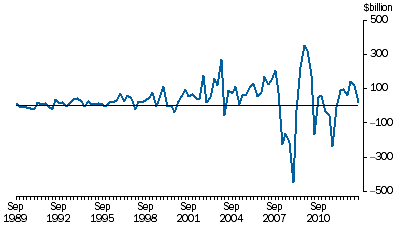
The ABS has prepared a Household Balance Sheet chart that demonstrates how these losses will be captured by the new analysis (see below).

Household Balance Sheet

It shows the balance of household net savings and other measures of real net wealth plunged from around $200 billion in late 2007 to almost negative $500 billion in the December quarter of 2008.

As the ABS notes, “much of the decline in household net worth in December 2008 is explained by large real holding losses on land and financial assets”. That is, the plunge in house and share prices (and the flow on effect to superannuation accounts) sent household net worth into a tailspin.

Importantly, these “paper” losses had immediate effects on behaviour. Households tightened their belts, cutting back on spending and increasing saving.

This change in behaviour, along with a recovery in house prices, helped to quickly send the household balance sheet back into positive territory.

Since the plunge in the balance sheet in late 2008, there have been two other periods in which it has fallen into negative territory before recovering – early-to-mid 2010 and mid-2011.

What may concern policymakers and businesses that depend on households to spend, is that the ABS chart shows the Household Balance Sheet has again turned down and is close to zero.

Strengthening housing and share markets might turn that around, but elevated unemployment and flat real income growth won’t provide much support.

Leave a comment

Filed under Uncategorized