Record-breaking run on inflation in sight

As it contemplates what has been an extraordinarily white knuckle few weeks for the global economy (courtesy of the insanity of sections of the Republican Party), at least one thing the Reserve Bank of Australia Board is  unlikely to worry about when it meets in a couple of weeks is domestic inflation.

The September quarter Consumer Price Index figures due out on Wednesday are expected to confirm that, whatever else might be going on the economy, it’s not happening in prices.

If they show, as tipped, that underlying inflation increased by around 0.5 per cent for the quarter, it will mean the nation is heading into the fourth consecutive year in which price pressures have been contained within the 2 to 3 per cent target band set by the central bank.

Since mid-2010, annual growth in underlying inflation has not reached any higher than 2.85 per cent, and has remained stuck around 2.4 per cent for more than a year.

Laudable as this result may be, it is not really remarkable.

In the sweep of time since the recession of the late 80s/early 90s and the establishment of an independent central bank, inflation has been largely well behaved – apart from a few quarters following the introduction of the GST in 2001 and the growing pains caused by the resources boom during 2007 and 2008 (see RBA chart below).
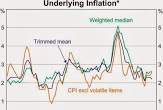
Underlying inflation 1993-2013 - RBA

If the RBA is correct in its view that inflation will remain within its target band for at least the next two years, it will mean more than five years of moderate price growth – a record-breaking achievement, exceeding the previous high of four consecutive years from mid-2002 when annual underlying inflation stayed between 2 to 3 per cent.

For a central bank which has as part of its mandate the containment of price pressures, this will be a signal achievement.

It also means that politicians may have to update their rhetoric and ditch the trusty old trope of “household cost of living pressures”.

For all the talk about cost of living pressures, there is little sign of them in the figures.*

* There is an argument to be had about whether the Australian Bureau of Statistics, with its CPI methodology, accurately encapsulates what households spend their money on, but this is a subject for a future post.

2 Comments

Filed under Uncategorized

Flat retail leaves rate cut door open

No wonder the Reserve Bank of Australia appears so comfortable with the inflation outlook.

When retail sales fail to grow in a quarter, and edge just 1.1 per cent higher in the course of a year, that tells you everything you need to know about the extent of consumer caution and a lack of pricing power among retailers.

For a central bank contemplating a cash rate cut to 2.5 per cent, the environment doesn’t get much more unthreatening than this.

And the RBA Board, when it meets tomorrow, will have to taker into account the market’s emphatic expectation that monetary policy will be eased.

But this rate cut will not be the political tonic that governments usually get from moves that make borrowing cheaper – this time around it is a potent sign of how soft conditions in the economy have become – and how much more work the RBA may yet have to do.

Leave a comment

Filed under Analysis

Tobacco excise hike not a long-term budget fix

It will be no surprise if there is a fall in rates of smoking after the announcement of a 12.5 per cent hike in the tobacco excise over the next four years.

Put up the price of cigarettes enough and even hardened smokers may think twice about the cost of their habit.

Treasurer Chris Bowen has been eager to repeat Heart Foundation claims that tobacco consumption tumbled 11 per cent when the excise was raised 25 per cent in 2010.

Higher prices are likely to be part of the explanation for a steady and sustained fall in rates of smoking – from 34 per cent of adults in 1980 to 17 per cent in 2010.

All in all, the excise increase is laudable as a public health measure.

But lets not kid ourselves that this is why the Government has taken the political gamble of jacking up the cost of smokes in the shadow of a federal election.

Any smokers who are encouraged to give up the habit, or any kids deterred from lighting up in the first place, is merely a happy by-product.

The Government’s real motive for the excise increase is to help plug the gaping hole in its revenue bucket.

According to the Treasurer, the change will net the Commonwealth an extra $5.3 billion over the next four financial years.

It is a hefty sum, but still well short of what the Government needs.

Bowen is expected to reveal tomorrow (August 2) there has been a $20 billion revenue write-down over the forward estimates.

That is why there is plenty of speculation swirling about what else might be cut, delayed or rejigged in order to staunch the haemorrhaging budget.

But back to the tobacco excise.

Two concerns immediately spring to mind – the credibility of the $5.3 billion revenue estimate, and reliance on excise revenue from a declining activity to help cover recurrent costs.

On the credibility issue, it is vital to know what assumptions Treasury has made in arriving at its estimate, particularly whether it factored in a decline in smoking rates and, if so, to what extent.

As mentioned earlier, the popularity of smoking has been in long-term decline.

Other assumptions Treasury may have made about smoker behaviour could also have important implications for revenue, such as the propensity to swap to cheaper brands as prices rise, or what might happen to the trade in illicit tobacco.

On the second concern, the Government could be setting up the budget for further trouble if it relies on the increased tobacco excise as part of a long-term financial fix.

Its own public health policies are aimed at the continued decline and eventual elimination of smoking.

This would certainly deliver big savings to the health budget in fewer cancers and less chronic disease, and would likely deliver a boost productivity because of fewer work days lost to illness.

If the proportion of smokers does indeed continue to decline, the only way to maintain the revenue stream will be to raise the excise even higher, encouraging even more to give up the habit.

It is similar to the problem created by trying to use a temporary burst of revenue (like a once-in-a-century surge in the terms of trade) to pay for massive ongoing personal income tax cuts (hello Peter Costello, hello Wayne Swan).

Smoking is very unlikely to die out (pardon the pun) as quickly as the commodity price boom, and tobacco excise revenue will probably continue to flow for many years to come.

But whoever is Treasurer in 2030 may find it is not the quick fix to a budget hole it once was…

2 Comments

Filed under Analysis

Kevin or Tony, business grinds on regardless

At about this point before every federal election, someone comes out and complain that political uncertainty is undermining business confidence and hurting investment.

True to form, business leaders were reported by The Australian earlier this week crying that doubts over when the election would be held were “sabotaging jobs and investment”.

We are led to believe that right now across the country, company boards, HR managers and purchasing departments are in a fit of angst about the current state of political flux, delaying crucial hiring and investment decisions as they wait on the Prime Minister to make the short drive to Government House to call the nation to the polls.

If this is the case, it must be an excruciating time for job seekers, merchant bankers, car salesmen and just about anyone else with something to sell.

It would mean that every three years or so – whenever an election looms – economic activity is brought to a virtual standstill as the nation awaits the verdict.

Problem is that, as with much received wisdom, it doesn’t stand up to much scrutiny.

Even a cursory inspection of official investment and employment figures suggests little correlation between election timing and swings in activity.

For instance, in the months leading up to the November 2001 election, private capital expenditure was regaining its momentum after having been savaged by the tech wreck. By the end of the year it had reached annual growth rate of almost 5 per cent – a 10 percentage point turnaround from the March quarter.

And again, in 2004, capex growth slowed in the three months to June to an annual rate of 2.5 per cent before accelerating sharply in the second half of the year to reach above 12 per cent in the December quarter – right when the election was held.

Of course, it has not all been one-way traffic.

Business investment was on a prolonged slide in the months leading up to the March 1996 election, when the Keating Government was dumped in a landslide.

But even here, other factors seemed to be at play.

Quarterly investment growth actually bottomed out the previous June (when it virtually stalled), and strengthened in the six months leading into the election. Maybe it was just that business was confident a change of government was on the cards.

The labour market similarly provides little support for the theory.

Just take these two examples.

In lead-up to, and aftermath of, the fractious August 2010 election, uncertainty about who would form government, and on what terms, was at an all-time high.

But throughout this extremely unsettled period, covering March to October, an extra 180,000 jobs were created, and total employment grew 1.6 per cent.

In 2007, the unemployment rate hovered at or below 4.3 per cent for the six months leading up to the November election, and rose only marginally to 4.5 per cent at election time before quickly reverting to 4.3 per cent the following month.

This is not to say that elections and the prospect of a change of government have no effect on businesses and the investment and hiring decisions they make.

Obviously, if the Federal Government is one of your important customers or a major employer in your area, you could well have a lot riding on the outcome of the poll (though neither side looks likely to unshackle Commonwealth spending any time soon).

But equally obviously, for most employers and investors the election and a possible change of government is only one of a number of considerations, and probably not a major one.

In the ebb and flow of domestic and international commerce, whether it is Kevin or Tony is ultimately neither here nor there – despite what people may claim.


Leave a comment

Filed under Analysis