OECD: global recovery is ‘real’ but weak

If you are after economic growth, then there’s really on one place to look – Asia (ex-Japan).

In its latest projections for global and large economy growth, the Organisation for Economic Cooperation and Development has revised down prospects for much of the world.

Australia is one of the few brighter spots in the developed world – the economy is expected to grow by 2.5 per cnet next year, and 3 per cent in 2015.

But the OECD’s outlook is premised on a number of important assumptions, not least that the Abbott Government doesn’t implement any more spending cuts than have already been factored in, and that the Reserve Bank of Australia continues to hold interest rates down.

The OECD’s far-from-buoyant view of the world economy in May has been replaced by an even less optimistic outlook, shaped by a series of disappointing results in some emerging economies and several disturbing developments – not least the ridiculous near-debt default in the US.

Nonetheless, such crazy political brinkmanship to one side, OECD Secretary-General Angel Gurria says the recovery underway in the global economy is “real” – you just might have trouble noticing it much for the next little while.

In figures released overnight, the OECD predicts global growth will accelerate from 2.7 per cent this year to 3.6 per cent in 2014 and 3.9 per cent in 2015.

The picture is even less impressive across the OECD member countries – average growth of 1.2 per cent this year, 2.3 per cent in 2014, and 2.7 per cent in 2015.

The US is expected to do ok – growing by 3.5 per cent by 2015, with unemployment headed down close to 6.1 per cent by December of that year.

But the outlook for the Euro area and Japan remains miserable – growth won’t break above 2 per cent in the former and will be well below 1 per cent in the latter.

Underlining the human tragedy of the deep recession in much of Europe, the Euro area unemployment rate is still expected to be close to 12 per cent by the end of 2015.

The really sobering thought in looking at these projections, is that they rely on so many things going right – not least that politicians in the US, Europe and elsewhere, don’t engage in yet more bouts of indulgent and destructive policies that undermine what financial stability there is or erect further barriers to international trade.

Risks abound.

The big plus for Australia is that China is expected to be one of the few bright spots in the global outlook, sustaining annual growth at or above 7.4 per cent over the next two years despite the deadweight of Europe and Japan.

Reflecting this, the OECD is a bit brighter than the Reserve Bank in its outlook for Australia – expecting that growth in the country will accelerate from 2.5 per cent next year to around 3 per cent in 2015 as activity in the non-mining sectors of the economy “gradually strengthens”.

But, it warns, this is outcome is far from a given.

It has warned the Abbott Government against any further fiscal tightening than has already been planned, and is advising the RBA to maintain its current accommodative monetary policy stance.

On taxation, it backs the business sector’s bid for a lower corporate tax rate.

On housing, it advises a shift to “more efficient” real estate taxation, which is code for the states to abolish stamp duties.

It will be interesting to see if the Government’s Commission of Audit is paying attention.
2 Comments

Filed under Uncategorized

ABS to give full reckoning of household wealth

There are plenty of reasons why households tighten their belts or splurge out on an overseas holiday.

But until now, the National Accounts have only shone a light on part of the picture – income – when it comes to explaining spending and saving behaviour.

That will change from next month when, for the first time, the National Accounts will include a quarterly report on the Household Balance Sheet that incorporates the effect of house prices, shares, superannuation and other assets as well as income on household net worth.

This is of more than just academic interest.

As the Australian Bureau of Statistics itself has pointed out, non-financial assets are a huge piece of the puzzle when it comes to evaluating real household worth, because they are about two-thirds larger than the value of financial assets.

As the ABS coyly admitted, this was “a significant data gap”.

In an explanatory note announcing the change, the Australian Bureau of Statistics has presented an analysis of how household net worth plunged when the global financial crisis hit hard in the second half of 2008.

Between March 2008 and June 2009, it plunged from around $6 trillion to close to $5 trillion, with much of the decline stemming from falls in the value of land, shares and superannuation accounts rather than cuts to income.

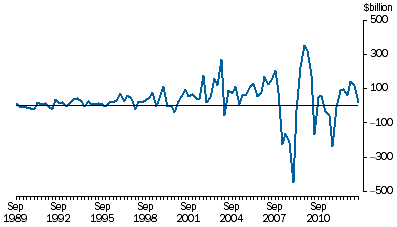
The ABS has prepared a Household Balance Sheet chart that demonstrates how these losses will be captured by the new analysis (see below).

Household Balance Sheet

It shows the balance of household net savings and other measures of real net wealth plunged from around $200 billion in late 2007 to almost negative $500 billion in the December quarter of 2008.

As the ABS notes, “much of the decline in household net worth in December 2008 is explained by large real holding losses on land and financial assets”. That is, the plunge in house and share prices (and the flow on effect to superannuation accounts) sent household net worth into a tailspin.

Importantly, these “paper” losses had immediate effects on behaviour. Households tightened their belts, cutting back on spending and increasing saving.

This change in behaviour, along with a recovery in house prices, helped to quickly send the household balance sheet back into positive territory.

Since the plunge in the balance sheet in late 2008, there have been two other periods in which it has fallen into negative territory before recovering – early-to-mid 2010 and mid-2011.

What may concern policymakers and businesses that depend on households to spend, is that the ABS chart shows the Household Balance Sheet has again turned down and is close to zero.

Strengthening housing and share markets might turn that around, but elevated unemployment and flat real income growth won’t provide much support.

Leave a comment

Filed under Uncategorized

Time to curb outrageous salaries – or lift investment?

People really have got Maurice Newman all wrong.

When the former ASX boss compared minimum wage rates across the Anglosphere and Europe, many assumed he was pushing for a pay cut for low paid workers.

In fact, in his roundabout way, he was making the case for the top-heavy wage structures of the major corporations to be heavily pruned.

He mightn’t have said so outright, but Newman was challenging company boards to rethink the way they set executive pay – instead of trying to match the highest rates on offer on the global market, he was urging them to go low-ball.

That, at least, seemed to be the logical extension of his argument.

In an incisive piece of analysis, uncluttered by arcane economic concepts such as purchasing power parity, Newman told the Committee for the Economic Development of Australia at a function on 11 November that a worker on the minimum wage in Australia working a 38-hour week earned $US33,355 a year, compared with $US22,776 a year for a worker on the Canadian minimum wage, and just $15,080 for an equivalent worker in the United States.

“We cannot hide the fact that Australian wage rates are very high by international standards,” he thundered, “and that our system is dogged by rigidities.”

His argument brought to mind an interesting piece of analysis in The Economist examining the labour share of national income. It cited figures from the Organisation of Economic Cooperation and Development showing that labour captured 62 per cent of all income in the 2000s, down from more than 66 per cent in the early 1990s.

The United States, which Maurice regards so enviously, has shared in the decline, though the pain is spread unevenly – there, the top 1 per cent of wage earners have seen their share of income increase while the remaining 99 per cent have suffered 4.5 percentage point decline.

As The Economist notes, this has meant that productivity gains are no longer translating into broad-based wage increases. Instead, the benefits are accruing to the owners of capital.

This is not just a northern hemisphere phenomenon.

Figures compiled by the Reserve Bank of Australia show that unit labour costs as a proportion of gross domestic product have shrunk since the early 1990s. And the latest Wage Price Index figures from the Australian Bureau of Statistics show that salaries are keeping just ahead of inflation – the index was up 0.5 per cent in the September quarter, taking annual wages growth to 2.65 per cent.

Interestingly, while some of this decline can be attributed to the effects of competition from cheaper imports, researchers at the University of Chicago have found that a substantial part of it is due to technology.

They found that the cost of capital goods, relative to consumer items, has plunged 25 per cent in the last 35 years, making it increasingly attractive to swap labour for technology.

If Maurice is really all about increased productivity, and isn’t just attempting to restart the class war from the top, he should drop his tired old wage cutting rhetoric and instead urge his business compadres to increase their capital investment.

Just a thought.

Leave a comment

Filed under Uncategorized

A shortage of jobs, but no shortage of work

In contemporary Australia there might be a (relative) shortage of jobs, but it seems there is no shortage of work.
While the unemployment rate hovers just below 6 per cent (it held steady at 5.7 per cent last month according to the latest official labour force figures), just about anyone with a job will tell you that their work demands are rising relentlessly.
So what is going on?
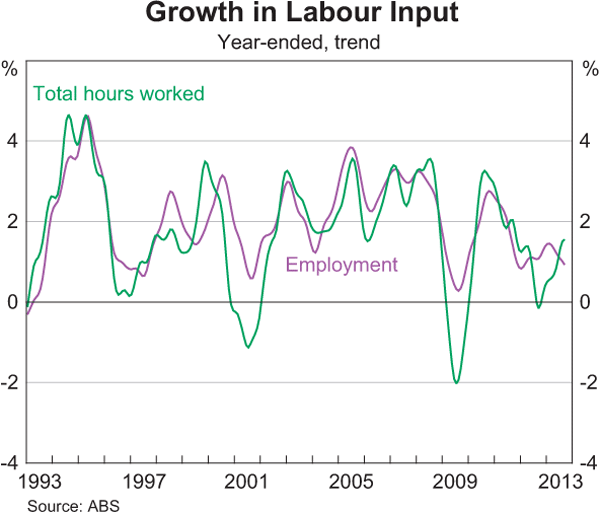
The latest official employment figures are consistent with a trend that emerged in the middle of last year in which employment growth is slowing but hours worked is accelerating (see Reserve Bank of Australia chart of labour input growth below).

10bl-labinpu

According to the Australian Bureau of Statistics, aggregate hours worked increased marginally in both trend and seasonally adjusted terms last month, while employment and unemployment were flat (a net 1100 jobs were created, while an additional 9000 job seekers joined the labour market).

The increase in pressure on those still with a job has been accentuated by the inclination of employers to take on part-timers over full-time staff – in the 12 months to October, 53,000 full-time jobs were lost, while during the same period 145,000 part-time positions were added.

Business surveys and the latest job ads report from the Australia and New Zealand Banking Group suggest wary employers are reluctant to take on extra staff.  According to the ANZ, the number of job ads has bottomed in the last two months after falling for most of the year, while an Australian Chamber of Commerce and Industry index of labour market conditions reached a four-year low of 43.6 points in the September quarter.

It is not hard to see why: though low interest rates have injected some vigour into the housing sector, the economy remains sluggish.

As RBA Governor Glenn Stevens observed earlier this week, the economy is still fumbling its way forward as the mining investment boom rapidly dissipates and other sources of growth are yet to establish themselves.

Couple this with the continued strength of the dollar and tepid global growth, and it is little wonder businesses are reluctant to take on extra staff.

Instead, as the data indicate, employers are choosing to use their existing workforce to cope with any increase in demand.

This is why those who have a job feel like they are working twice as hard, even as hundreds of thousands are banging on the door looking for employment.

Leave a comment

Filed under Uncategorized